
Talbot County Parole Versus Probation
Maryland assigns these forms of supervision in different ways. Parole is a conditional release during a sentence and follows a decision by the Maryland Parole Commission. Probation is imposed by a court. It may begin after a jail or prison term, or the court may order it without a prison term. Mandatory supervision is a third route. It follows release based on sentence and diminution credits, which are lawful reductions earned under Maryland rules. The Maryland Division of Parole and Probation, or DPP, supervises people on all three tracks.
A Talbot County court docket may show that probation was ordered, but it may not prove the term remains active today. Likewise, a parole approval is not the same as release. The Maryland Parole Commission says prerelease conditions, such as an approved home plan or required programming, can delay departure. The responsible correctional agency records the actual release event.
| Supervision type | Who authorizes it | Best record path |
|---|---|---|
| Parole | Maryland Parole Commission | Commission hearing material, sentence record, VINE, and DPP guidance |
| Probation | District or Circuit Court | Maryland Case Search, the clerk’s file, and DPP guidance |
| Mandatory supervision | Release under Maryland sentence-credit law | DPSCS records, VINE, sentence documents, and DPP guidance |
- Parole
- Conditional community release while part of a sentence remains.
- Probation
- A court-ordered community term with stated conditions.
- Mandatory supervision
- Supervision after a statutory release based on sentence and earned credits.
- Discharge
- The lawful end of a custody or supervision term.
Verify Talbot County Post-Release Supervision
Maryland has no public DPP database that accepts a person’s name or identification number and returns a current supervision result. The public DPP pages describe agency work and list offices. They do not establish whether a named person is on parole or probation. A careful check uses several records because each answers a different part of the question.
- Search Maryland Judiciary Case Search by name. Limit the review to Talbot County, and check both District and Circuit Court. Match case numbers and other available identifiers.
- Read the sentence and later docket entries. Look for probation terms, modification orders, violation activity, or a revocation. Read each dated entry in the context of the full term.
- For possible parole, review the open parole hearing calendar when relevant. Its name, SID, date, time, and location show a scheduled open hearing, not a release or decision.
- Check Maryland VINE for a custody or supervision event tied to the correct record. Treat an alert as a prompt to confirm, not as the supervision file itself.
- Contact the Easton DPP office and ask for the proper verification or records route. Staff may be unable to disclose a named person’s status.
The sequence matters. An empty state custody locator cannot prove parole because Maryland removes people who are no longer in covered DPSCS custody. An old probation entry also cannot establish current status without the term length and later orders. For the prior jail episode, the county release record establishes departure; the Talbot County release search and record path explains how that custody fact is confirmed.
Case Search is a public summary rather than the complete court file. A Talbot District Court matter may later appear in Circuit Court, so both levels need review. Remote results may also narrow after sealing, shielding, expungement, or Maryland’s rules for some non-conviction outcomes. When a supervision term cannot be resolved from the summary, request the complete file from the correct clerk instead of treating an absent entry as proof that the term ended.
The Talbot County Corrections page identifies the county jail contact, while the county PIA process is the written route for an existing local discharge record. The Talbot County Sheriff’s Office FAQ confirms that the Sheriff does not operate the jail. That local division matters because a Sheriff incident file cannot substitute for the Corrections record that shows how county custody ended.
Talbot County Supervision Office Records
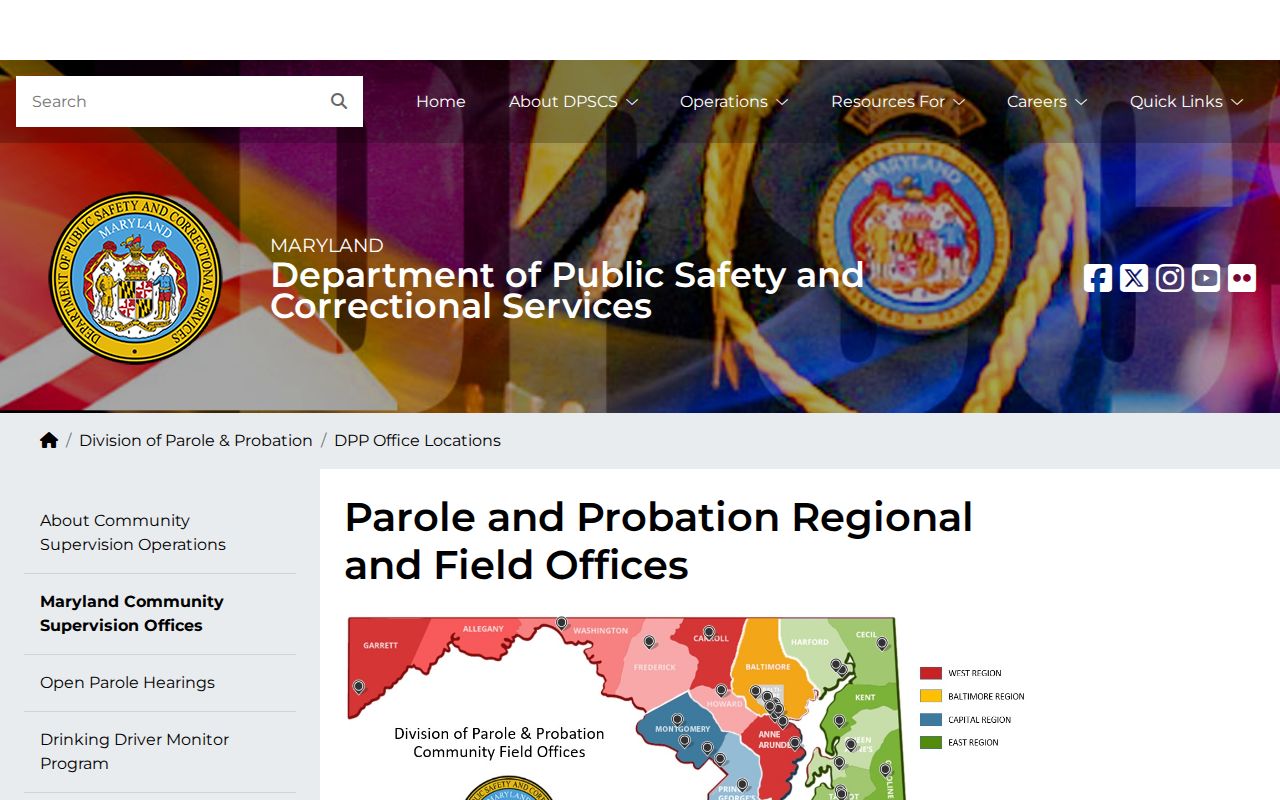
Talbot County is served by two DPP units at the same Easton address. The Field Office/DDMP handles local process guidance, while the East Regional Office provides regional administration. The official DPP office directory gives separate suites and phone numbers. It does not publish public hours, so call before visiting.
Easton Field Office/DDMP
301 Bay Street, Suite 302
Easton, MD 21601
410-763-4950
Fax: 410-763-7916
East Regional Office
301 Bay Street, Suite 303
Easton, MD 21601
410-822-5050
The official Easton directory view below confirms both offices and helps prevent calls to the wrong suite.
The paired entries are a routing aid. They are not a person-level supervision search, and an office contact does not guarantee disclosure of a named record.
For a parole-process question that the field office cannot resolve, the Maryland Parole Commission is at 6776 Reisterstown Road, Suite 302, Baltimore, MD 21215. Its phone numbers are 410-585-3200 and 877-241-5428. The Commission handles parole decisions and hearings. DPP handles field supervision. Keeping those roles separate avoids attributing one agency’s decision to another.
Talbot County Reentry After Release
Talbot County Corrections lists a local set of programs that can shape the path from custody into the community. The Corrections programs page names Re-Entry, Detention Case Management, House Arrest and Alternative Sentencing, Weekender, Work Release, Pre-trial Services, medication-assisted treatment, and Re-Entry and Community Collaboration. These are distinct from DPP supervision, although a person’s court order or release plan may connect to more than one service.
The county does not publish detailed eligibility or public intake steps for each program. Contact Talbot County Corrections or its Programs Coordinator for current process information rather than inferring eligibility from a program name. A work-release or house-arrest placement also should not be described as an unconditional release. The underlying order, the custodian’s record, and any DPP term control the accurate description.
This local program landscape is useful when reading a court docket. An entry mentioning alternative sentencing, pretrial services, or work release may explain how custody changed, but it does not by itself state that parole or probation began. Match the program entry to the sentence and the actual Talbot discharge event.
Talbot County Supervision Violations
Conditions vary with the court order, parole action, and supervision plan. A violation allegation may lead to a hearing, warrant, revocation, or another lawful response. Revocation means supervision is withdrawn and custody or a new sentence consequence may follow. It is not safe to infer a violation merely because a person missed contact with family or no longer appears at a known address.
No official public Talbot County absconder list was found. An absconder is a person whom the supervising authority alleges has stopped reporting or cannot be located as required. DPP maintains enforcement functions, but its violation-reporting channel is not a public lookup. Emergency concerns go to 911. Other reports should follow official DPP instructions. Never label a person an absconder from stale private information, an unanswered phone, or a failed name search.
Maryland VINE can carry some parole and probation events, including agent changes and violation-hearing results, when the relevant track supplies them. Registration must match that supervision track. Even then, the court, DPP, or Commission record remains the better source for the legal action.
Easton Post-Release Office Pairing
The Suite 302 and Suite 303 pairing is a distinctive Talbot County routing detail. The Field Office/DDMP is the closer contact for local parole and probation process questions. The East Regional Office is a regional administrative unit. Their shared street address does not make their roles or phone lines interchangeable.
When calling, state which source led to the question: a Talbot court docket, an MPC hearing listing, a VINE event, or a DPSCS record. Give a case number or SID when lawfully available and ask for the correct records process. Do not ask staff to create a new public answer or disclose restricted details. A concise, record-based question is easier to route.
No public hours appear in the directory. That absence should remain explicit. A page or private directory that supplies unverified hours is less reliable than the official state listing.
Talbot County Supervision Discharge
Supervision can end through expiration of the ordered term, court action, agency discharge, revocation, or another lawful action tied to the supervision type. A discharge is the formal end of the applicable term. It should not be inferred from silence in a public database because Maryland offers no such person-level database.
For probation, compare the original sentence with later Talbot District or Circuit Court entries and, when needed, obtain the clerk’s complete file. For parole or mandatory supervision, use the responsible DPSCS, DPP, or MPC records path. VINE may signal a status change, but its alert is not the discharge document. If records conflict, the office that created the fact should be asked to review its own entry.
Dates need labels. A court order date, parole approval date, release date, supervision start date, violation date, and discharge date can differ. Preserve the source and the date checked. That record trail supports a precise statement such as “the court docket recorded probation” without stretching it into an unsupported claim about present status.
Note: A parole approval can precede release because programming, a home plan, or an institutional event may delay the actual departure.