
Talbot County Projected Versus Actual Release
A projected date is a forward-looking sentence-management calculation. It can reflect the maximum term, effective sentence start, presentence custody credit, concurrent or consecutive terms, mandatory portions, and credits that have been earned or revoked. The actual release date is recorded when the responsible custodian completes departure. A parole eligibility date, parole approval date, mandatory or conditional release date, maximum expiration date, and final discharge date are also different events.
Talbot County Detention Center holds both pretrial and sentenced people. A pretrial detainee does not have a sentence-based projected date. Release may depend on a Commissioner or court order, bond terms, dismissal, a warrant check, a detainer, or later case action. Even after a judge orders release, Corrections must complete lawful processing. For a sentenced person, Talbot Corrections or DPSCS performs the applicable calculation according to the place and authority of confinement.
- Projected date
- An agency’s current planning calculation based on known sentence facts and credits.
- Parole eligibility
- The point when an eligible sentence may be considered for parole, not a release order.
- Detainer
- A request or legal basis for another authority to hold or receive the person.
- Actual release
- The completed custody event recorded by the facility or corrections agency.
Find Talbot County Projected Release Dates
There is no single public search for an individual Talbot County projected release date. The route depends on the custody system and sentence. Maryland’s current-custody locator accepts first and last name, but it does not display a projected or tentative date. Talbot JailTracker is also current-only and does not publish a county release calendar.
- Identify the current custodian. Use Talbot JailTracker only to rule in displayed county custody and the DPSCS locator only to rule in covered state custody.
- Search both Talbot court levels through Maryland Judiciary Case Search. Match the case and read the judgment, sentence, custody-credit orders, and later modifications.
- For a Talbot jail sentence, call Corrections at 410-770-8120 for process guidance. Ask how to request an existing sentence-calculation or discharge record rather than asking staff to calculate a date from scratch.
- For state custody, use DPSCS records or the responsible case-management channel. Do not expect the public locator to return a projected date.
- Check for parole action, detainers, consecutive cases, or court changes that may affect departure. Register with Maryland VINE for notice, then confirm the event with the custodian.
The DPSCS Incarcerated Individual Locator states that people no longer in custody are not listed.
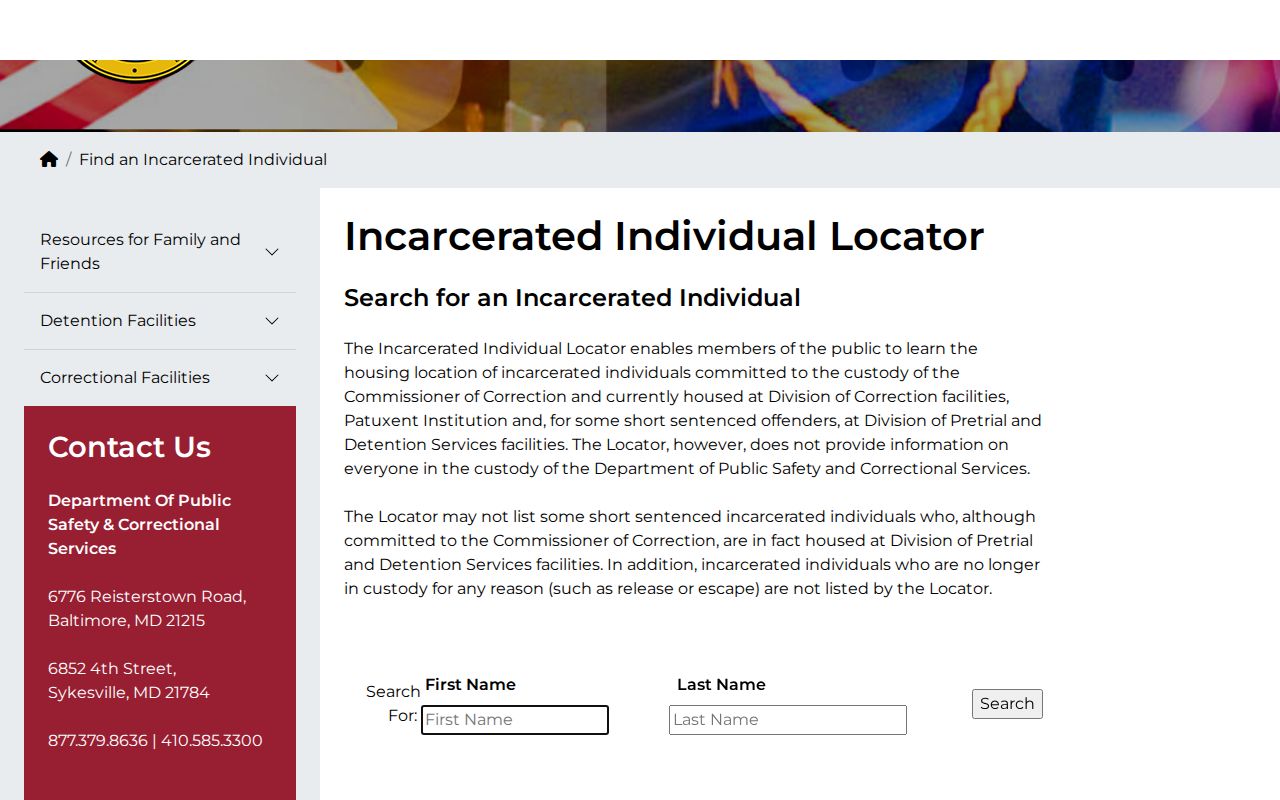
This current-custody screen can confirm a displayed state custody record. Its silence cannot supply a release date or prove community release.
Talbot County Release Date Calculation
A sound calculation begins with the sentencing documents, not the charge label or an online sentence length. Maryland Criminal Procedure §6-218 provides credit for qualifying time spent in custody because of the charge or conduct. The calculation may also require the effective start date, partial months, concurrent or consecutive treatment, and any portion that is mandatory or not paroleable.
For state custody, Correctional Services §3-704 generally awards ten days of good-conduct credit per calendar month, but five days per month applies when a term includes a crime of violence or specified controlled-substance offense. The statute prorates partial months and excludes periods when sentence-service credit is not running. Section 3-705 provides five days per month for satisfactory assigned work. Section 3-706 supplies five days for satisfactory progress or completion in listed programming.
Special project and program credit can add another layer. Section 3-707 allows up to twenty days per month in general and up to ten days for specified violent, registrable sex, or drug sentences. Section 3-708 caps total monthly credits at twenty days for the described restricted group and thirty for others, subject to the statute’s conditions. Credits are not automatic guesses. DPSCS applies the rules to the actual sentence and record.
Maryland has no blanket rule that every person must serve eighty-five percent of a sentence. For a violent crime committed on or after October 1, 1994, §7-301 generally sets parole eligibility at the greater of one-half of the aggregate violent sentence or one-quarter of the total aggregate sentence, with special rules for mixed terms. Section 7-501 affects conditional release for certain violent crimes committed on or after October 1, 2009. Offense, sentence, and date control the result.
Talbot County Jail Release Credits
Local correctional sentences use a related Maryland framework. Correctional Services §§11-503 through 11-507 address qualifying presentence and postsentence credits for a local facility such as Talbot County Detention Center. Section 11-503 concerns five days per month of qualifying presentence credit for discipline compliance and diligent labor until sentence, state commitment, or release.
Section 11-504 provides initial postsentence good-conduct credit of five days per month for violent or specified drug sentences and ten days otherwise. Sections 11-505 and 11-506 permit added five-day credits for exceptional tasks, education or vocational progress, and designated special projects or programs. Section 11-507 allows revocation with due process.
The court docket establishes the sentence and judicial credit orders. Talbot Corrections applies the local calculation and records the actual discharge. Do not compute a personal release date by subtracting a generic monthly number from the stated sentence. Partial months, offense categories, disciplinary action, multiple cases, and later court orders can change the result.
Talbot County records should also separate a commitment to local custody from a later commitment or transfer to DPSCS. The local calculation answers only the time administered by Talbot Corrections. Once the state becomes the responsible custodian, the state sentence and credit record controls its projected date. A single court case can therefore produce more than one custody milestone, and none should be collapsed into one unlabeled “release date.”
Note: A county sentence-credit estimate is not a Talbot Corrections record and should never be presented as the official release date.
What Changes Talbot County Release Dates
Several events can move a projected date or prevent community release when one term ends. Each factor should be traced to the agency responsible for it. The court controls its sentence and orders. Talbot Corrections controls its county calculation and discharge record. DPSCS controls the state calculation. The Maryland Parole Commission controls parole action.
| Factor | Possible effect | Where to verify |
|---|---|---|
| Credit earned or recalculated | Moves the planning date under the applicable statute | Talbot Corrections or DPSCS calculation record |
| Credit revoked | Can move the date later after the required process | Responsible correctional record |
| Court correction or modification | Changes the term, start, or relationship between sentences | Talbot court docket and clerk’s file |
| Detainer or pending case | May lead to transfer or continued custody after one term ends | Originating and receiving agency records |
| Parole approval or delay | Can create a conditional path, subject to prerelease requirements | MPC, DPSCS, and VINE records |
| Institutional event | May suspend approval or affect credits | Responsible facility or agency record |
A transfer ends one custody episode but is not release into the community. If Talbot sends someone to DPSCS, another county, BOP, ICE, or another authorized custodian, the county roster may drop the record while custody continues. Use “transferred out of Talbot custody” when the record supports that outcome.
Maryland’s Internal Projected Release Date
Maryland’s public locator omits the very field many readers expect. It does not show a projected date, actual release date, supervision status, or historical “Released” result. DPSCS does use the phrase “projected release date” inside its own work. The DPSCS Reentry Unit says reentry planning begins within 180 days of that date and that an individualized plan enters the release envelope.

The reentry material proves that an internal planning calculation exists. It does not turn that calculation into a public person-search field.
This difference should guide every lookup. A current match in the locator can establish covered state custody as of the displayed update. A missing match can mean release, escape, a coverage exception, or another record condition. Move from the public locator to DPSCS records, the sentencing docket, VINE, and applicable parole or supervision offices. Never publish an inferred projected date from locator silence.
The internal date also serves planning rather than public certainty. Reentry work may address documents, services, and a proposed release plan while the sentence calculation remains open to lawful change. The fact that planning begins within a stated period does not mean every person leaves at the end of that period. It shows why an agency may use a projected date even though the public-facing locator does not reveal it.
Confirm Talbot County Actual Release
For a Talbot jail release, the actual discharge or transfer record is the best source for physical departure. A same-day court order establishes legal authority, but the jail may still need to process paperwork, warrants, or detainers. Request an existing booking, calculation, discharge, or transfer document through the county PIA route when a durable record is needed.
The Talbot JailTracker roster can rule in displayed current custody but cannot return a projected date. Use the Talbot County Corrections page for the jail contact and the county PIA page for a written records request. The Talbot County Sheriff’s Office FAQ confirms that prisoner questions go to Corrections, not Sheriff dispatch, because the Sheriff does not run the jail.
For state custody, confirm the event with DPSCS records. Parole approval alone is not enough. The Maryland Parole Commission says approvals often depend on a certified home plan, programming, or other prerelease conditions and can be delayed or suspended. For a pending notification, the Talbot County VINE inmate check explains registration and the need to register again at custody boundaries.
Keep dates labeled by function. Record the sentence date, credit order date, projected date, parole action date, VINE alert time, and actual release date separately. When two sources conflict, ask the source responsible for that fact to review it. Corrections is authoritative for the physical event, the clerk for the judicial order, DPSCS for the state calculation, and MPC for its parole action.
The Talbot County released-inmate record path can then supply the broader timeline. Use cautious wording until an affirmative record appears. “Not displayed in the locator on this date” is accurate. “Released” is accurate only when the responsible source establishes release.